Introduction
PostgreSQL has emerged as the world's most advanced open-source relational database management system, and its relevance has continued to grow stronger in 2025. Developers and enterprises continue to select it as their top database choice because of its superior features, scalability, and advanced open-source framework. Whether you're building web applications, handling complex transactional systems, or managing massive datasets, PostgreSQL offers the reliability and flexibility modern applications demand
Open-Source and Cost-Effective
One of PostgreSQL's most compelling advantages is that it's completely free and open-source. This helps businesses avoid the high costs of commercial database solutions like Oracle or SQL Server while still enjoying enterprise-grade performance. There are no hidden licensing fees, making it an ideal choice for both startups and large enterprises.
Advanced SQL Compliance and ACID Properties
PostgreSQL delivers complete ACID compliance, which maintains transaction reliability and data integrity. It enables complex queries, joins, and subqueries and stays close to SQL standards, making it highly compatible with other SQL environments. The system includes advanced SQL features such as window functions, foreign key constraints, triggers, and stored procedures.
JSON and NoSQL Flexibility
PostgreSQL bridges the gap between relational and NoSQL databases with its robust JSONB support. This allows developers to benefit from both relational consistency and NoSQL flexibility in a single database system.
Horizontal Scalability and Performance
PostgreSQL enables horizontal scaling through streaming replication and logical replication, helping manage heavier workloads while maintaining high system availability. Its partitioning feature allows administrators to split massive datasets into smaller segments, which boosts scalability and performance.
Extensibility and Custom Data Types
PostgreSQL's architecture allows for custom data types, operators, functions, and extensions. This extensibility enables developers to define and align their database to how they want data represented in their applications.
Robust Security Features
PostgreSQL provides SSL encryption, row-level security, and precise access controls to ensure reliable data protection. It features authentication mechanisms including LDAP and SCRAM-SHA-256, enabling businesses to connect with their established security systems.
Full-Text Search Capabilities
PostgreSQL includes built-in full-text search functionality without requiring external tools.
Active Community and Continuous Innovation
PostgreSQL benefits from a vibrant open-source community that continually enhances its capabilities. The recent PostgreSQL 18 release (September 2025) brought significant improvements, including virtual generated columns, 40% reduction in memory usage for joins with large datasets, and 15% faster execution times for EXISTS subqueries.
Market Leadership
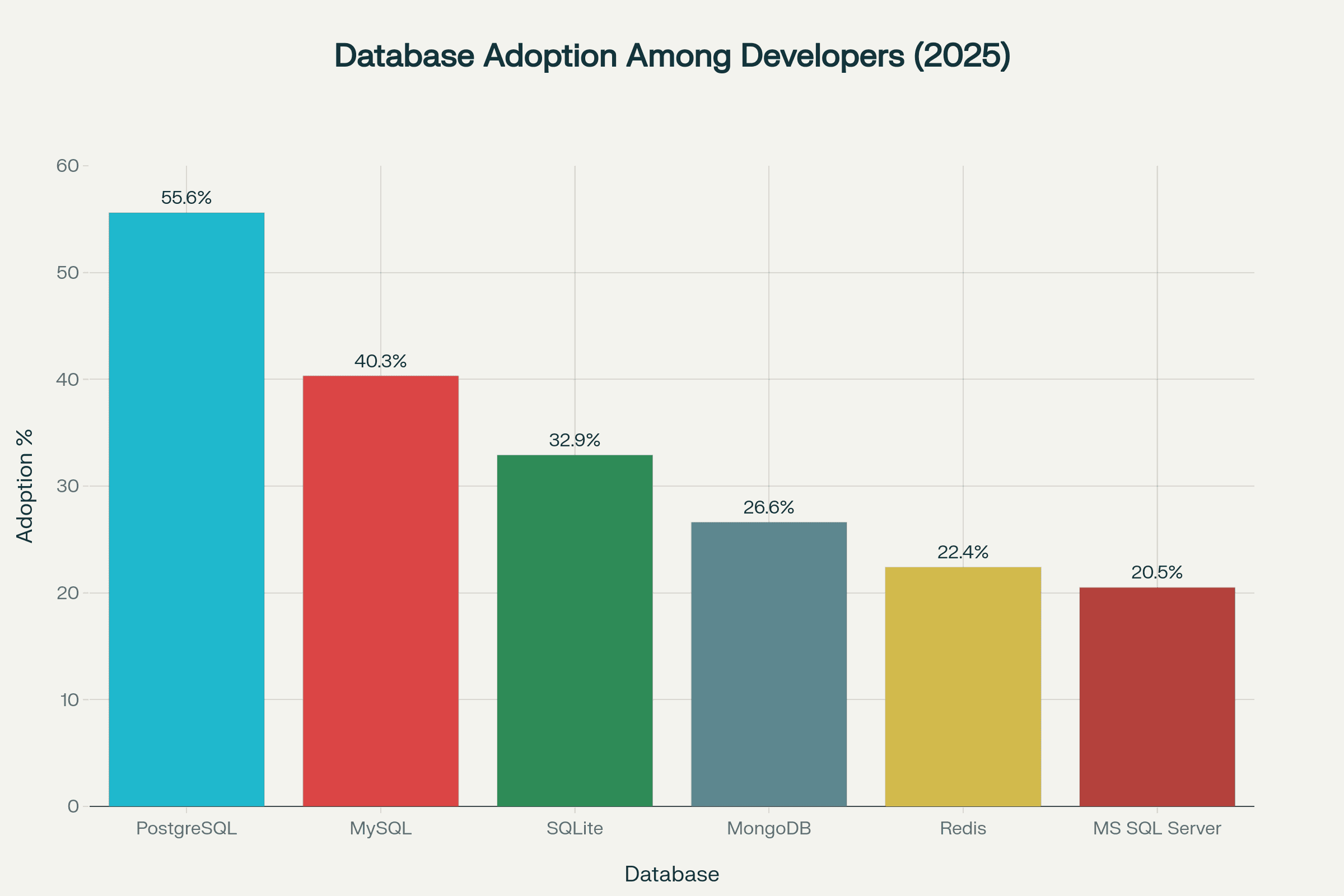
PostgreSQL commands a dominant 55.6% adoption rate among developers in 2025, establishing a clear 15.3 percentage point lead over second-place MySQL at 40.3%. This represents PostgreSQL's strongest market position yet, with SQLite at 32.9%, MongoDB at 26.6%, Redis at 22.4%, and Microsoft SQL Server at 20.5%. Among professional developers in enterprise scenarios, PostgreSQL's advantage becomes even more pronounced at 58.2%, opening an 18.6 percentage point gap over MySQL.
Real-World Use Cases
PostgreSQL is successfully used by major companies, including Netflix, Instagram, and Spotify, for their critical applications. It's particularly suitable for web applications, e-commerce platforms, analytics systems, and any application requiring reliable transactional processing.
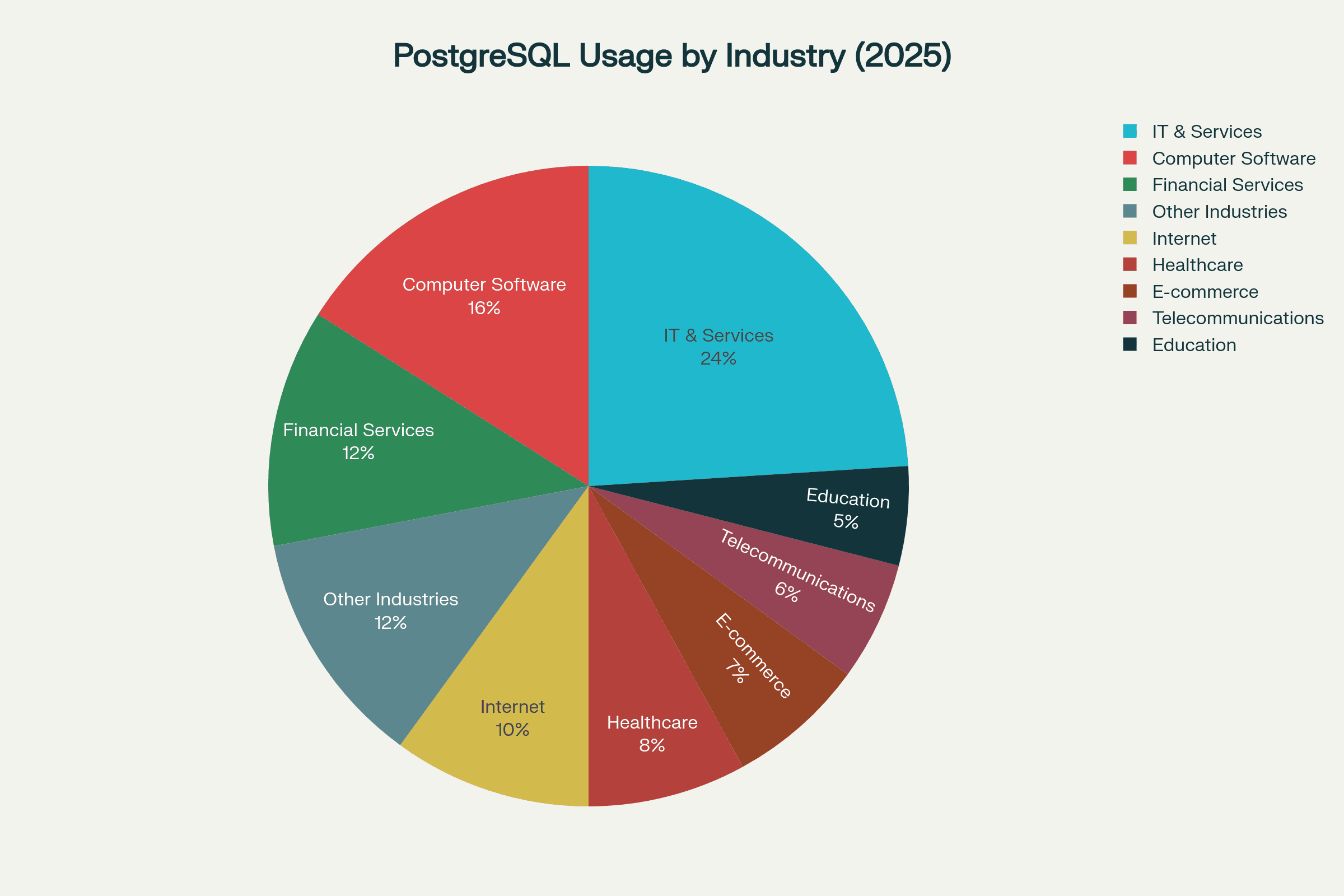
PostgreSQL has achieved widespread adoption across diverse industries, with Information Technology and Services leading at 24%, followed by Computer Software at 16%. Financial services organizations account for 12% of PostgreSQL usage, leveraging its ACID compliance and transaction reliability for mission-critical applications. Internet companies (10%), healthcare organizations (8%), and e-commerce platforms (7%) have also embraced PostgreSQL for their data management needs. Over 101,000 companies worldwide use PostgreSQL, with 37% based in the United States, 6% in India, 5% in France, and 5% in the United Kingdom. Notably, 17% of PostgreSQL users are large enterprises with over $1 billion in revenue, demonstrating its capability to scale for enterprise-grade applications.
Cloud-Native and Enterprise Ready
PostgreSQL is cloud-agnostic, making it easier to deploy and scale across different cloud providers. Its reliability, security, and performance have earned it a place in many enterprise-grade applications.
Choosing the right names for your API endpoints is crucial for building an intuitive, consistent, and easy-to-use API.
Deep dive into database indexes with practical examples and performance insights. Learn how to create, optimize, and manage indexes across PostgreSQL, MySQL, and MariaDB. Includes detailed code examples, best practices, and real-world scenarios to boost query performance by up to 100x.